
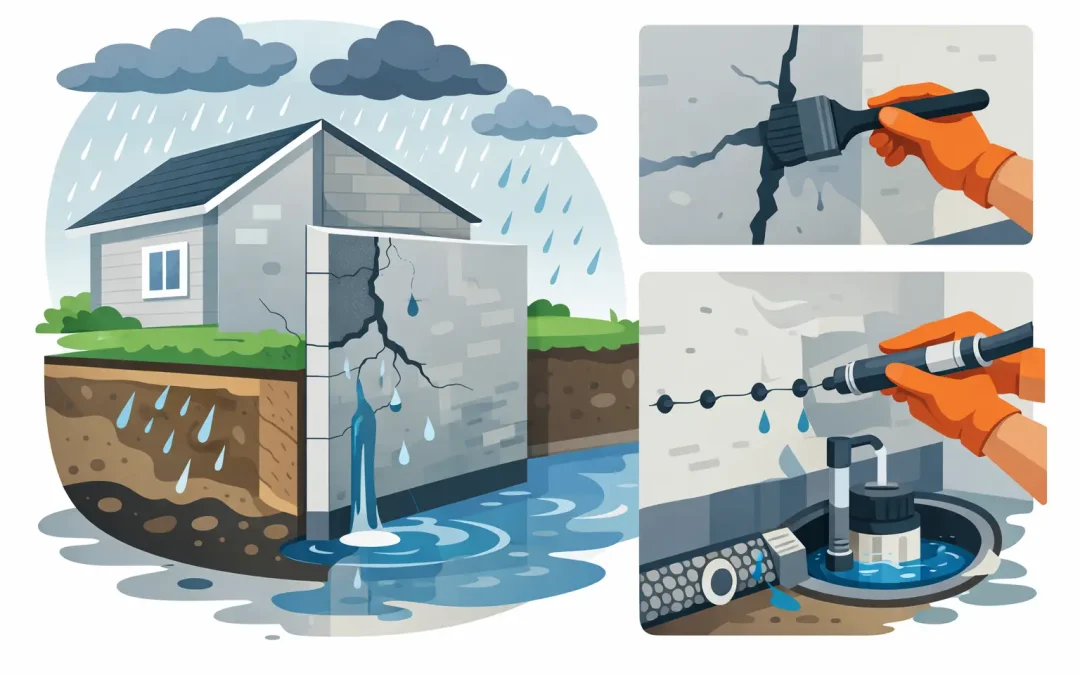
A damp line near the floor, a white powdery deposit on concrete, or water appearing after a hard Bay Area rain is more than a cosmetic concern. Homeowners often ask, why do basement walls leak, when the wall itself appears solid and intact. In most cases, the visible water is the final result of a drainage, waterproofing, or structural issue outside the basement – not simply a problem on the interior surface.
Basement leakage deserves prompt attention because moisture can damage finishes, create conditions for mold, corrode metal components, and expose developing foundation movement. The right repair depends on where water is entering, what is driving it toward the wall, and whether the foundation has any structural distress.
Why Do Basement Walls Leak During Rain?
Concrete is strong under compression, but it is not naturally waterproof. It contains microscopic pores, and it can develop shrinkage cracks as it cures. When soil around a basement becomes saturated, water follows the path of least resistance through cracks, construction joints, penetrations, and porous concrete.
Rain is often the trigger, but the underlying cause is usually poor water management. A properly designed basement system must move surface water away from the building, relieve groundwater pressure near the foundation, and maintain a continuous waterproofing barrier on the exterior wall. If any part of that system is missing, damaged, or overwhelmed, water can find its way inside.
The timing of the leak offers useful clues. Water that appears only during or immediately after rainfall often points to roof runoff, surface grading, clogged drains, or an opening higher on the wall. Water that develops hours or days later may indicate saturated soil and hydrostatic pressure building against the foundation. A persistent damp area during dry weather can be related to groundwater, plumbing, condensation, or an active drainage failure.
The Main Causes of Basement Wall Leaks
Poor grading and concentrated roof runoff
The soil around a home should slope away from the foundation so rainwater drains outward rather than collecting beside the basement wall. Over time, settlement, landscaping changes, patios, and hardscape can create low spots that direct water back toward the building.
Downspouts can make the problem worse when they discharge next to the foundation. A large roof can send a significant volume of water into one small area during a storm. That water quickly saturates backfill soil, increasing pressure against the basement wall and exploiting weak points in the waterproofing system.
Hydrostatic pressure in saturated soil
Hydrostatic pressure is one of the most common reasons below-grade walls leak. When water fills the soil pores around a basement, it exerts pressure against the wall. The deeper the wall and the wetter the soil, the greater that pressure can become.
This pressure can push water through hairline cracks and joints that might otherwise remain dry. It can also cause exterior waterproofing membranes to fail if they were improperly installed, deteriorated with age, or damaged during backfill. In hillside areas and locations with variable soils, seasonal groundwater and runoff patterns can make this issue more pronounced.
Failed or missing exterior waterproofing
Waterproofing is applied to the exterior face of a basement wall before soil is placed back against it. Depending on the project, the system may include a fluid-applied membrane, sheet membrane, protection board, drainage mat, sealed penetrations, and detailing at footing-to-wall joints.
Older homes may have only a basic damp-proof coating, which is not designed to resist standing water or hydrostatic pressure. Even newer work can leak when the membrane has gaps, is not properly tied into the footing drainage system, or was punctured during construction. Interior coatings may reduce minor moisture vapor, but they do not stop water pressure coming from outside.
Cracks, cold joints, and utility penetrations
Not every foundation crack is structurally serious, but any crack can become a water path. Vertical cracks are often caused by concrete shrinkage or minor settlement. Diagonal cracks may require closer evaluation because they can be associated with differential settlement, lateral soil pressure, or movement around openings.
Water also enters at cold joints, where separate concrete placements meet, and around pipes, conduits, and other penetrations. These locations need deliberate waterproofing details. Simply filling the interior side with caulk or patch material can be a temporary measure, but it does not address water collecting behind the wall.
Blocked or inadequate footing drains
A perimeter footing drain is intended to collect water at the bottom of the foundation and carry it to an approved discharge point. If the drain is clogged with fine soil, crushed, improperly sloped, or never installed, water can remain trapped at the footing.
That condition keeps the lowest portion of the basement wall under constant moisture exposure. It also increases the chance of water entering at the wall-footing joint, which is a frequent leak location. Repairing this problem commonly requires excavation, drain replacement, proper gravel and filter fabric, and verification of where the system discharges.
Structural movement and aging construction
Foundation movement does not automatically mean a major failure, but it should never be ignored when it occurs with leaks. Soil expansion and contraction, settlement, inadequate drainage, seismic forces, and changes to the load above can all affect a basement wall.
Cracks that widen, offset surfaces, bowed walls, sticking doors, or recurring water intrusion deserve a qualified assessment. In some situations, crack repair and waterproofing are enough. In others, underpinning, shoring, wall reinforcement, or a more comprehensive foundation repair may be needed before the waterproofing work can perform as intended.
How to Identify the Source Before Choosing a Repair
A dependable repair begins with diagnosis, not a product recommendation. The first step is to determine whether the moisture is coming through the wall, at the floor-wall joint, from above grade, through a penetration, or from a non-foundation source such as plumbing.
Look for patterns. Efflorescence, the white mineral residue left as water evaporates, suggests recurring moisture migration through concrete. Rusted fasteners, peeling paint, soft drywall, and moldy baseboards show where water has traveled, but not always where it entered. The entry point may be several feet away or on the exterior side of the wall.
A professional evaluation should consider the exterior grade, gutters and downspouts, drainage paths, visible wall cracking, soil conditions, footing drain access, and the condition of existing waterproofing where it can be observed. For basement renovations, additions, or excavation projects, this assessment should be coordinated with structural plans and site drainage requirements rather than treated as an isolated finish issue.
Repairs That Address the Cause, Not Just the Symptom
The appropriate repair ranges from straightforward drainage corrections to excavation and full exterior waterproofing. If roof runoff and negative grading are the main contributors, extending downspouts, regrading soil, and correcting hardscape drainage may substantially reduce water at the foundation.
For a localized crack that is stable and accessible, professional crack injection can be effective. Epoxy is generally used when structural bonding is required, while polyurethane injection is often selected for active water seepage because it expands and reacts with moisture. The proper material depends on crack behavior and the repair objective.
When a basement wall is exposed to persistent groundwater or failed exterior protection, exterior excavation is usually the most durable solution. The work may involve excavating to the footing, cleaning and repairing the wall, installing a continuous waterproofing membrane, protecting it from damage, and rebuilding the footing drain with appropriate aggregate and filter fabric. This is more involved than an interior patch, but it addresses the water before it reaches the concrete.
Interior drainage systems can be useful where exterior access is limited or where groundwater conditions make relief necessary. However, they manage water after it reaches the foundation perimeter. They do not replace exterior waterproofing when the wall itself is deteriorated, cracked, or being exposed during a larger construction project.
When a Leak Calls for Structural Expertise
A leaking basement wall should be treated as a structural concern when there are signs of movement, significant cracking, wall displacement, or a planned project that changes loads or soil conditions. This is especially relevant for homes adding a basement, expanding below grade, building an ADU near an existing structure, or excavating beneath an older home.
These projects require coordinated work across excavation, shoring, drainage, structural concrete, and waterproofing. Completing one portion without considering the others can create expensive rework. Benitez Concrete Construction approaches basement and foundation work as an integrated system, with attention to site conditions, structural requirements, code compliance, and long-term water management.
A dry basement is not achieved by covering up a stain on the inside wall. It comes from controlling water at the site, relieving pressure at the foundation, and repairing the wall with methods suited to its actual condition. Address the first signs of leakage before the next storm turns a manageable repair into a larger foundation project.